
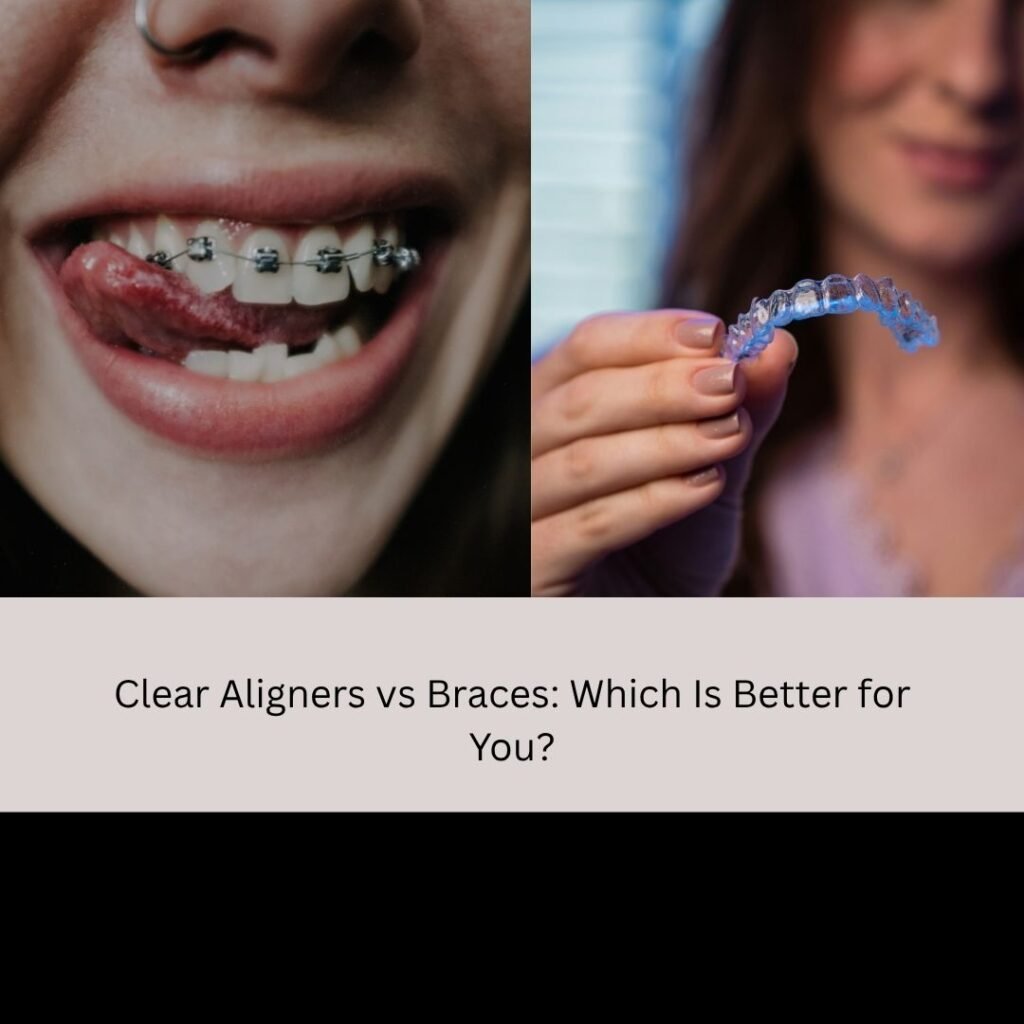
A straight, healthy smile can improve both your appearance and your confidence. If your teeth are crowded, crooked, spaced out, or have certain bite problems, orthodontic treatment can help. Today, clear aligners and braces are two of the most commonly considered options for achieving a straighter smile. If you’re looking for clear aligners in Vizag or considering braces in Visakhapatnam, understanding the differences between these treatments can help you make an informed decision with the guidance of your dentist or orthodontist.
But which one is better for you?
The answer depends on several factors, including your dental condition, treatment goals, lifestyle, budget, and how consistently you can follow your orthodontist’s instructions. Let’s look at the differences between clear aligners and braces to help you understand your options.
What Are Clear Aligners?
Clear aligners are removable, transparent trays that are custom-made to fit over your teeth. They gradually move the teeth into their desired positions by applying gentle, controlled pressure.
Patients usually wear their aligners for most of the day and change to a new set according to the treatment plan provided by their dentist or orthodontist.
Because the trays are transparent, they are less noticeable than traditional braces. They can also be removed while eating and during brushing and flossing.
What Are Traditional Braces?
Traditional braces use brackets attached to the teeth and a wire that connects them. The wire applies controlled pressure to gradually move the teeth.
Modern braces are available in different forms, including metal and tooth-coloured options. Your orthodontist can recommend the most suitable type based on your dental needs.
Unlike clear aligners, braces remain attached to your teeth throughout treatment and are adjusted periodically by your orthodontist.
Clear Aligners vs Braces: Key Differences
1. Appearance
One of the main reasons people choose clear aligners is their appearance. Since the trays are transparent, they are generally less noticeable when worn.
Traditional metal braces are more visible because of the brackets and wires. However, tooth-coloured or ceramic braces can provide a less noticeable alternative.
If appearance is a major concern, clear aligners may be an option worth discussing with your dentist.
2. Removability
Clear aligners can be removed when eating, drinking certain beverages, brushing, and flossing. This can make maintaining your normal oral hygiene routine easier.
Traditional braces cannot be removed at home. You need to clean carefully around the brackets and wires to prevent food from becoming trapped.
3. Eating
With clear aligners, you generally remove the trays before eating. This means you can usually continue enjoying a wide variety of foods.
With traditional braces, certain hard, sticky, or chewy foods may need to be avoided because they can damage brackets or wires.
4. Oral Hygiene
Keeping your teeth clean is important during any orthodontic treatment.
Clear aligners can be removed, allowing you to brush and floss your teeth normally. However, the aligners themselves also need to be cleaned properly.
With braces, brushing and flossing can take more time because you need to clean around the brackets and wires carefully.
5. Treatment Discipline
Clear aligners are removable, which is convenient, but this also means the patient needs to be responsible about wearing them as instructed.
If you frequently remove your aligners or do not wear them for the recommended amount of time, treatment may not progress as planned.
Braces are fixed to your teeth, so you do not have to remember to put them back in after eating.
6. Dental Problems Being Treated
Both clear aligners and braces can correct several common orthodontic concerns. However, they are not equally suitable for every patient or every type of tooth movement.
Depending on the severity and complexity of your case, your orthodontist may recommend braces, clear aligners, or another orthodontic treatment.
This is why an examination is important before deciding which option to choose.
Are Clear Aligners Better Than Braces?
There isn’t one treatment that is better for everyone.
Clear aligners may be suitable for people who want a more discreet orthodontic option and are comfortable following a removable-tray treatment plan.
Braces may be preferable when more complex tooth movements are required or when a fixed appliance is considered more appropriate for the individual’s dental condition.
Your dentist or orthodontist can assess your teeth, bite, jaw relationship, and overall oral health before recommending a treatment.
How Long Does Treatment Take?
Treatment duration varies from person to person. It depends on factors such as the degree of tooth movement required, the complexity of the case, the chosen treatment method, and how well the treatment instructions are followed.
Some cases may be completed relatively quickly, while more complex cases can take considerably longer.
Rather than choosing a treatment based only on the expected duration, it is better to focus on the treatment that is appropriate for your specific dental needs.
Which Option Is Right for You?
When deciding between clear aligners and braces, consider:
- Your current tooth alignment
- The type and severity of your bite problem
- Your preferred appearance during treatment
- Your daily routine and lifestyle
- Your ability to follow treatment instructions
- Your oral hygiene habits
- Your treatment goals
- Your dentist or orthodontist’s recommendation
A consultation can help determine which treatment is appropriate for your smile.
Take the Next Step Toward a Straighter Smile
Both clear aligners and traditional braces can help improve tooth alignment and create a healthier-looking smile when they are appropriately prescribed and managed.
The right choice isn’t simply about which treatment looks better. It should be based on your dental condition, treatment requirements, lifestyle, and professional evaluation.
If you’re considering clear aligners or braces, schedule a consultation with a qualified dentist or orthodontist. They can examine your teeth and bite and explain which treatment options may be suitable for you.